
Hiking Morro Do Costao & The Sublime Itacoatiara Beach
BRAZIL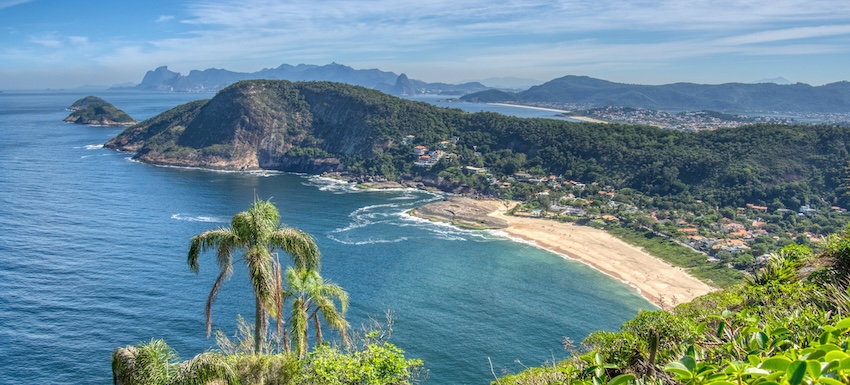
11 June 2025
Hiking Morro De Costao And The Sublime Itacoatiara Beach

Rio de Janeiro’s beaches are rightly lauded as some of the most iconic in the world. Indeed, anyone who visits the city invariably heads to the delights of Ipanema and Copacabana at some point. They’re less likely, however, to make the relatively easy trip over Guanabara Bay to Niterói, Rio’s under-the-radar neighbour and home to a range of fabulous Atlantic-facing beaches.
There are plenty to choose from, but hands down our favourite is Praia de Itacoatiara (pronounced ee-ta-co-atchee-AH-ra) – a superb stretch of fine powder sand bookended by two granite peaks. It gets swamped at weekends when locals from Niterói and Rio pack their cars with deckchairs, surfboards, footballs and picnic boxes for a day of doing what Brazilians do best. But during the week, it’s a much more relaxed affair.
Better still, there’s a superb hiking trail through the forest up to Morro do Costão (aka Costão de Itacoatiara), from where there are panoramic views of the beach below and across Niterói to the incredible Rio skyline.
Disclosure: This page contains affiliate links, which means that if you ultimately make a purchase, we earn a small commission at no extra cost to you. And it helps to keep our content free!
The Costao de Itacoatiara Trail
To access the trail, take the last turn on the left before the beach along Rua Matia Sandri into Rua das Rosas. It’s a wide, cobbled residential street with whitewashed walls bearing splashes of violet bougainvillea. Although there’s no signage to indicate it, the trailhead is a ten minute walk further on. Here’s my account of the hike…
As I head along Rua das Rosas, the towering granite of Pedra do Elefante (named because it resembles the head of an elephant) rises in front of me. To my right, the route to the summit of Costão de Itacoatiara is hidden behind a daunting sheer rock face.
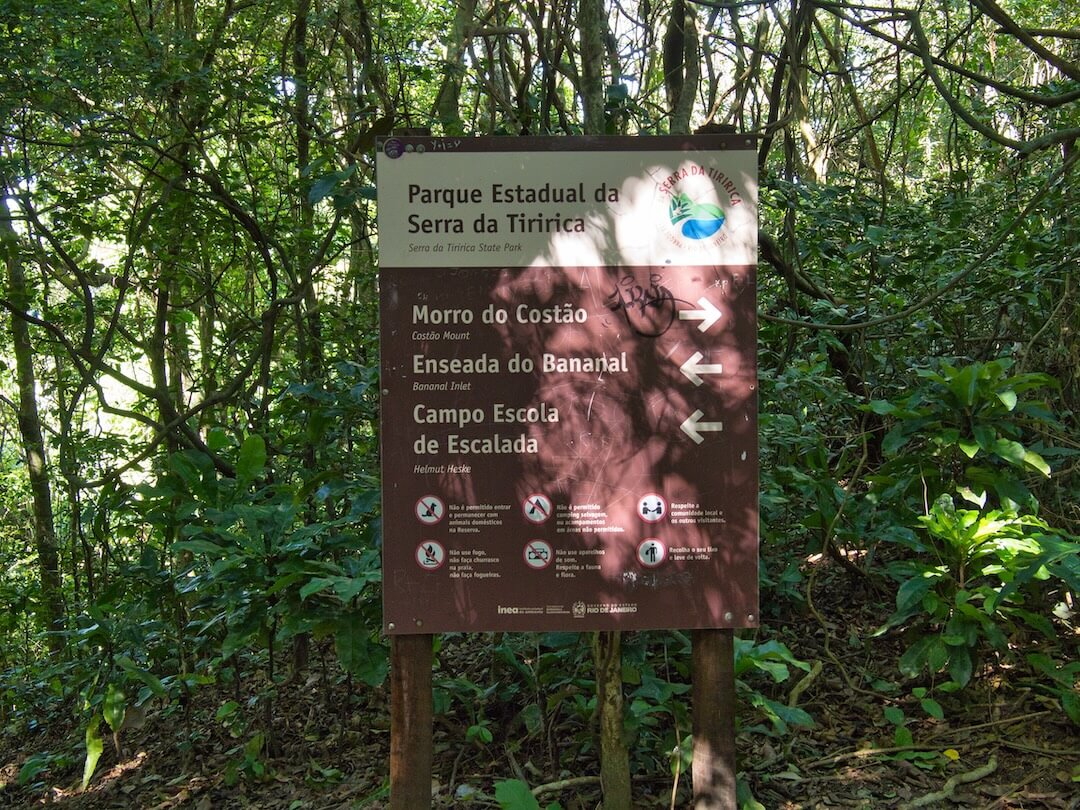
I reach the trailhead, which is actually an entrance to the Parque Estadual da Serra de Tiririca, a state park encompassing both peaks. However, before I can head on I have to provide my name, nationality and date of birth to a military police-uniformed steward, who dutifully adds me to a list of fellow hikers (presumably to ensure everyone is accounted for by the time the trail closes at 17:30).
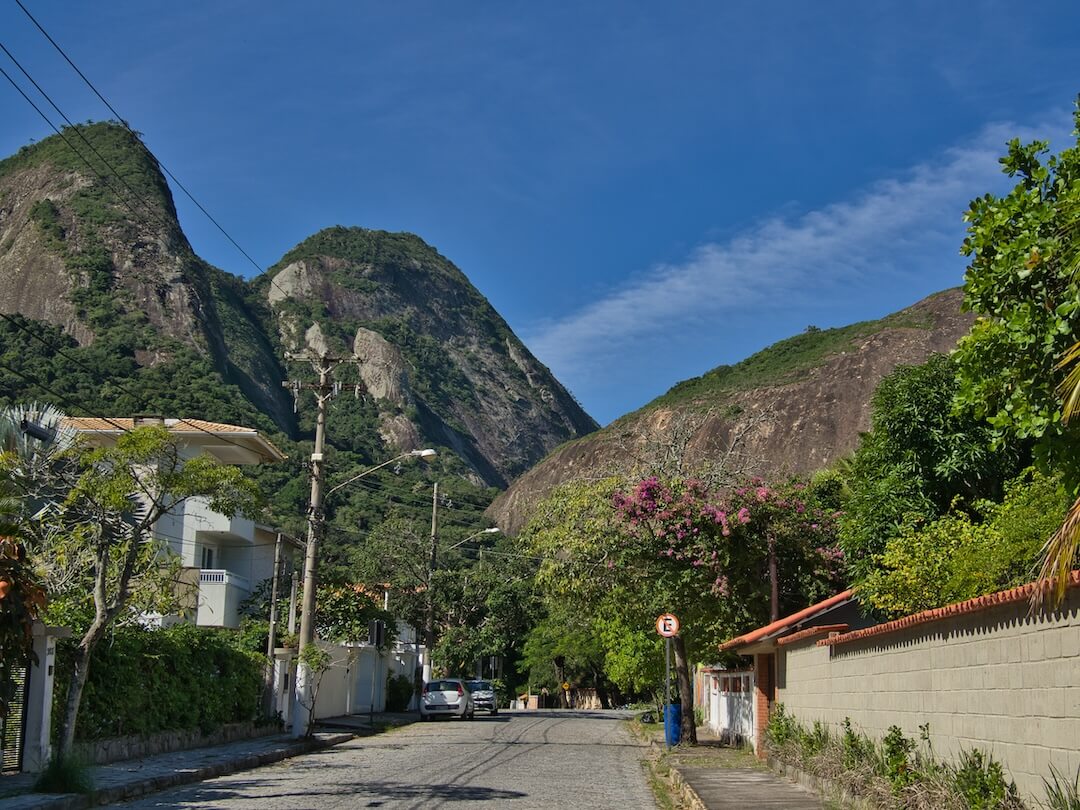
Rua das Rosas, with Pedra do Elefante in the background
From there the trail, a combination of dirt and tree roots, climbs and winds its way through the forest. Five minutes in and I’m “greeted” by a lone marmoset, a type of small monkey I’ve encountered many times during our stay in Brazil. Figuring its main objective is to relieve me of the contents of my rucksack, I allow it a momentary stare before brushing past.
Just ten minutes further on, I reach a signpost outlining the choices from here.
Have you considered house sitting?
Over the years we've saved thousands of pounds on accommodation costs by house sitting all over the world. If you’re new to the concept but want to give it a try, you’ll need to sign up for one or more specialist websites that connect homeowners with potential house sitters. The world’s largest platform is Trusted Housesitters, with tens of thousands of opportunities around the globe.
By creating a free account with them you can preview what housesits are currently on offer, filtered by country, region or city.
You can do that by following this link and choosing the “Find a house sit” tab. If you then decide to join as a member, you’ll also receive a 25% discount on your first year’s subscription.

Ahead, the trail continues downwards to a sheltered cove at Bananal. However, my route is to the right, where a few steps further on I reach a wall of granite rising sharply from the forest. It marks the beginning of the trail’s toughest section and has to be scaled using a rope handrail.
It might look daunting, but once I’ve pulled myself up onto the rockface it’s a surprisingly easy ascent. Indeed, the greater challenge comes when I reach the top and the handrail finishes. There’s more bare rock requiring some scrambling. And it’s pretty steep. So much so that I see a woman ahead who’s frozen with fear to the rock, her arms and legs ready for the next step but stuck in limbo.
After some cajoling from her partner, she eventually moves, enabling me to follow. Incredibly, there are people beside me clambering over the rockface in flip flops. Personally, I’m just grateful my walking shoes have a good grip because any slips from here would see me returning directly to the forest below in record time.
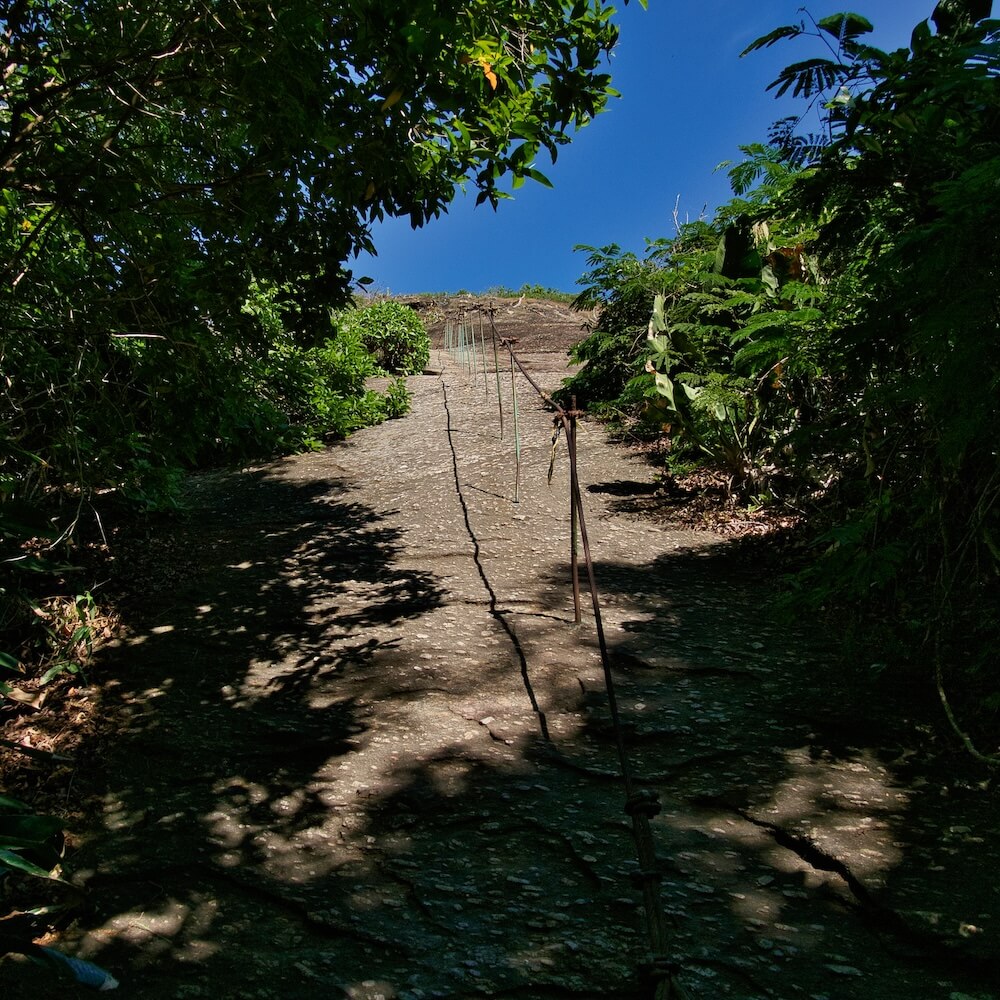
A helping handrail points the way
Arriving at a flatter section, it’s time for a breather and to take a look around. I look behind me to see a group of eight black vultures soaring above the forest, the tips of their vast wings seemingly dipped in white paint. Meanwhile, the Jurassic Park-like mass of Pedra do Elefante stretches away to the right. To my left, I can just see the outline of Rio’s mountainous skyline through a gap between the forest and the rockface.
But when I turn around and look ahead, I’m confronted with another section of bare rock. Not as steep this time, but there’s much more of it.
The climb starts to feel a little relentless as I push on to reach the summit. To my left, the view begins to reveal the much higher Pedra do Elefante in its full jumbo glory. Its elephant head seemingly looking out to the horizon, with its trunk plunging into the sea, it too features a trail to the summit.
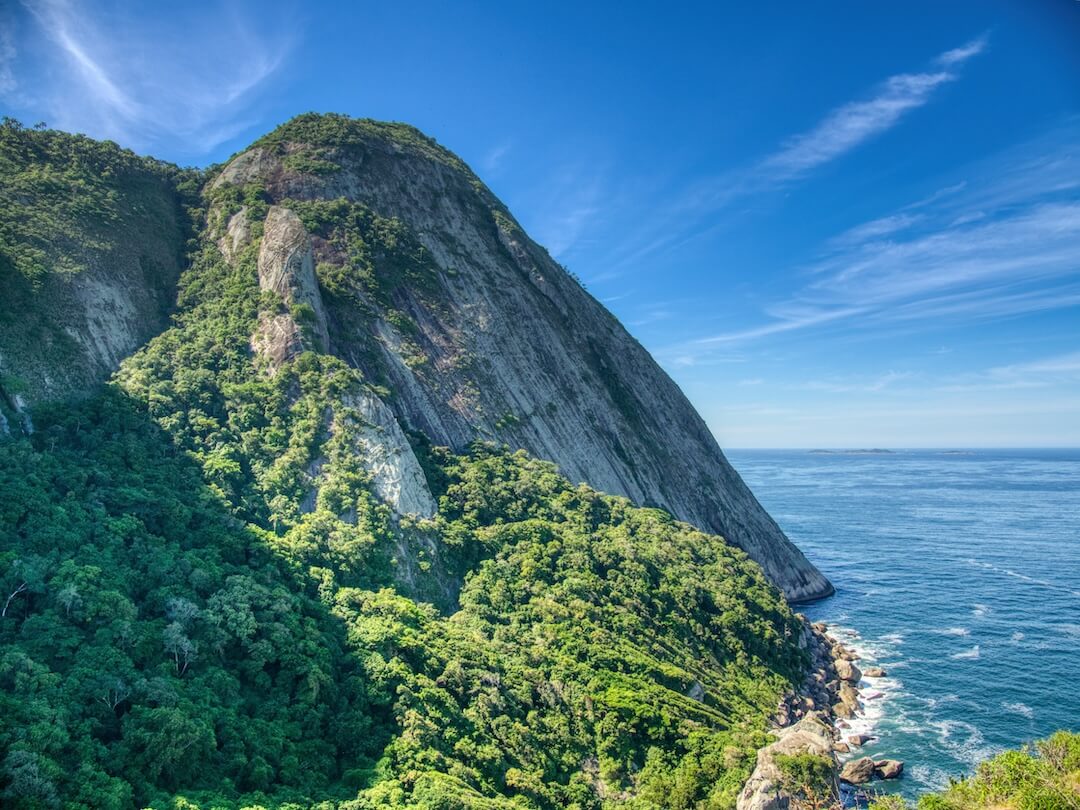
Pedra do Elefante
And, finally, 30 minutes or so after starting from the trailhead, I’ve reached the summit of Morro do Costão. Which is basically a rocky plateau interspersed with a curious mixture of cactus, palm trees and other random foliage.
The view to the right, over to Rio de Janeiro, is astonishing. Beyond the grey, naked plateau edge, the white sand of Itacoatiara Beach stretches to a forested headland (Morro das Andorinhas). Beyond, the twin beaches of Camboinhas and Piratininga sparkle and curl around a wide bay. And, in the background, the unmistakable south Rio peaks of Sugarloaf, Corcovado, the Two Brothers and Pedra de Gavea. All protected by a blue sky sprinkled with a dusting of wispy, feather clouds.
Suffice to say, it’s time to rest tired calf muscles, take a seat on the bare rock and drink in the panorama.
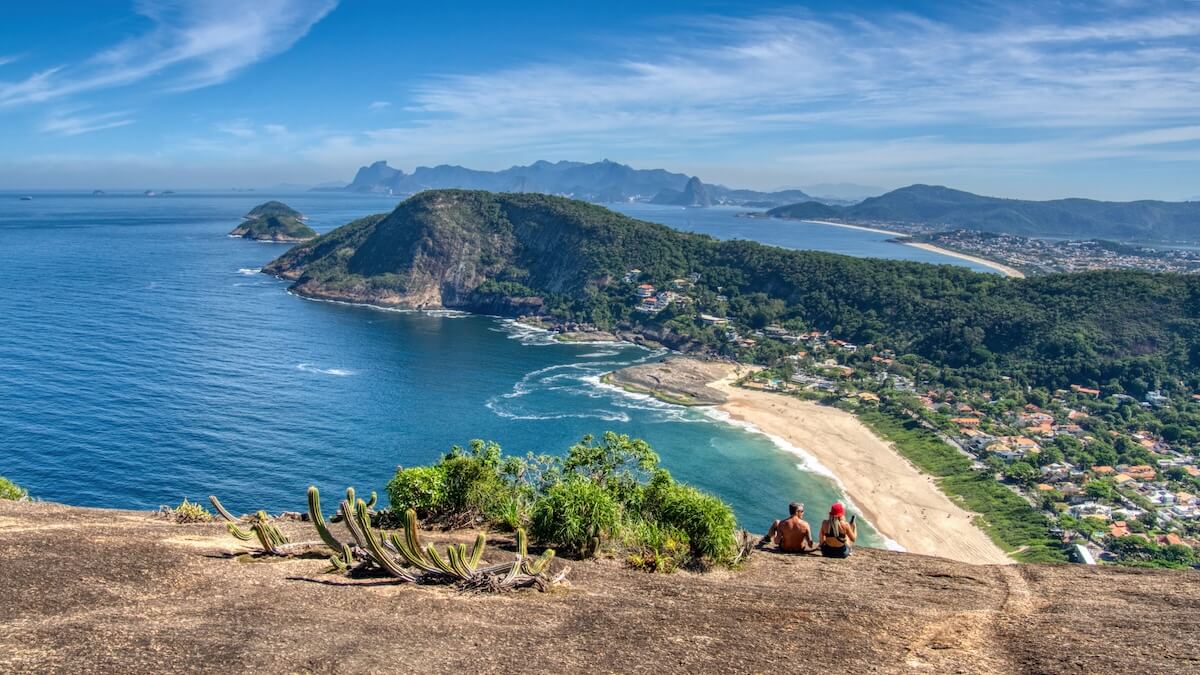
Not a bad spot for a picnic
But it doesn’t end there. At the very end of the plateau, a “hidden” narrow trail cuts through a section of foliage. Heading downwards through ever-encroaching vegetation and seemingly going nowhere, I consider turning back. But my return is stopped by another hiker who insists it’s worth the extra five minutes to brave a sometimes hairy skirmish on bare rock with a drop directly into the sea.
Emboldened by my earlier rock climbing pursuits, I agree to follow. And, sure enough, I’m glad for my well-gripped footwear. The end of the line is another flat section of rock looking east, beyond Pedra do Elefante and along the coast toward Maricá.
It doesn’t quite compare to the panorama of Rio, but it’s still a wonderful spot for a few restful moments.
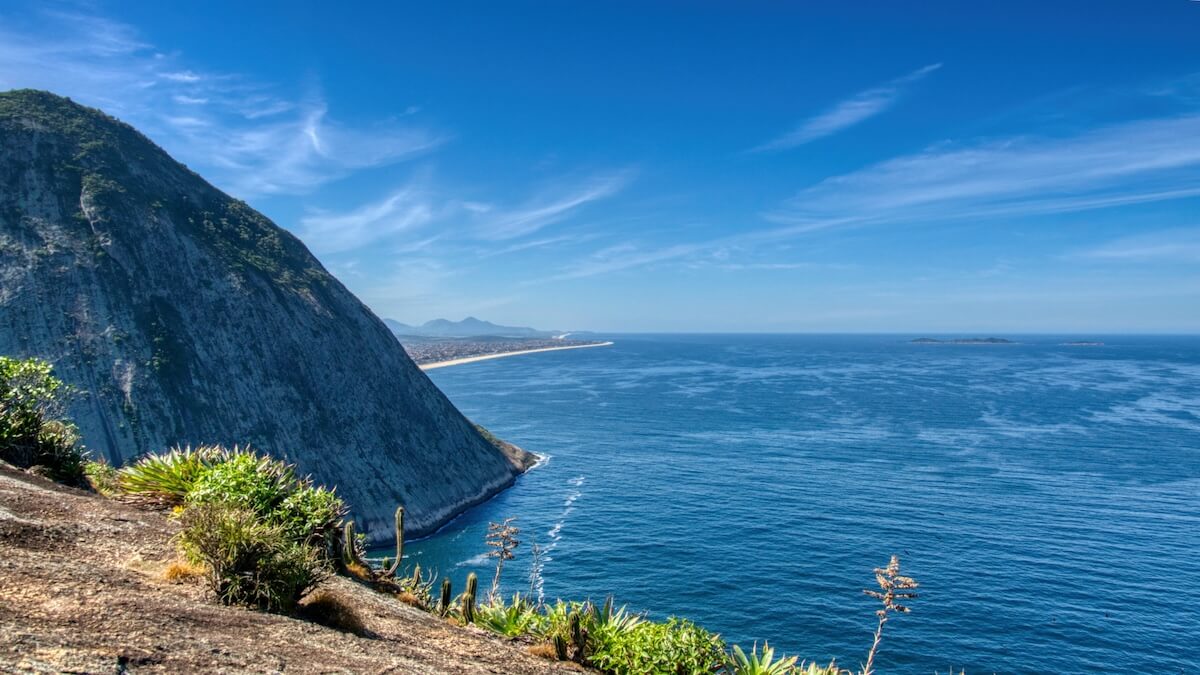
Looking east beyond Pedra do Elefante
Back on the main plateau, I decide it’s time for a closer look at the beach.
Although the “edge” of the plateau looks like a sheer drop, it actually slopes away for a while before it suddenly plummets 200 metres to the sands below. Not something anyone should consider doing on a wet or windy day, I nevertheless take baby steps down the slope until I’m looking directly onto the beach.
I can hear the faint mumbling of people’s voices amidst the soothing tones of the surf as it washes ashore. In the water, a dozen or so surfers prepare for the arrival of a suitably robust wave. Meanwhile above me, circling black vultures are silhouetted against the sky. The optics are not lost on me, so I take a few photos and make a hasty retreat.
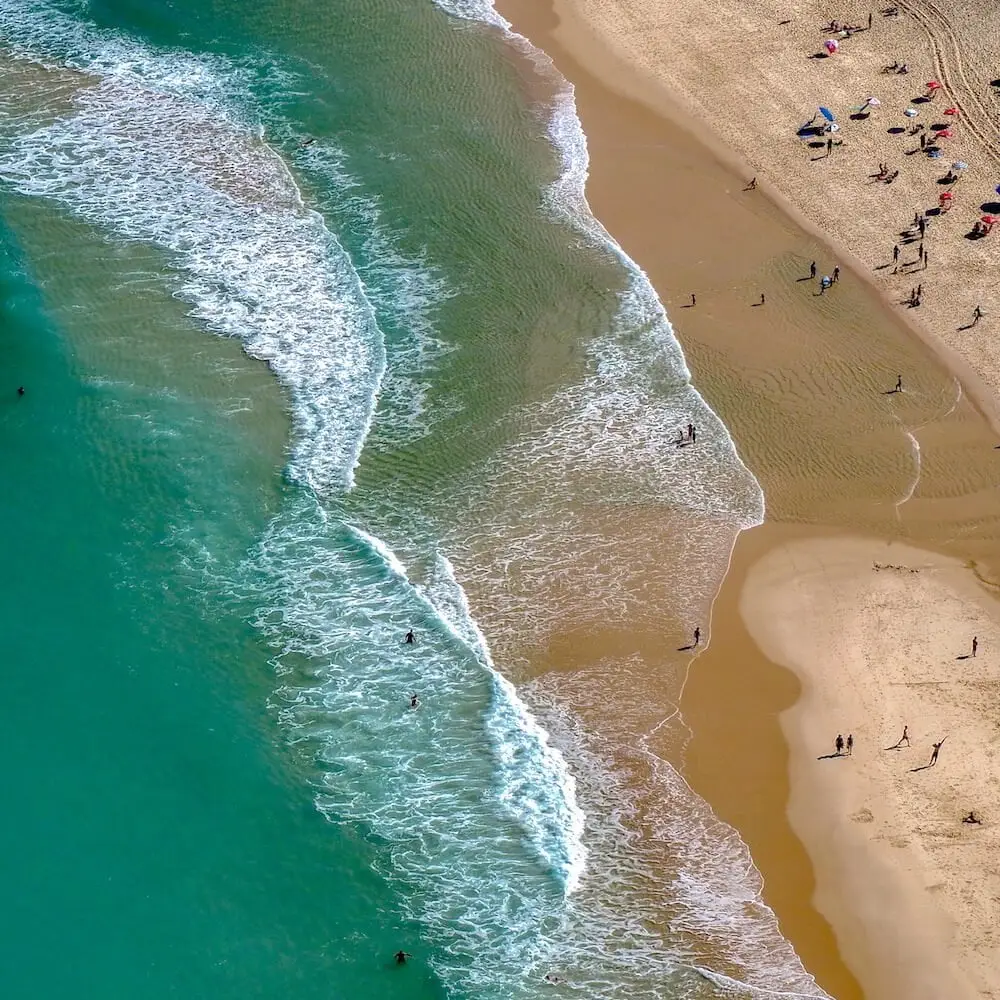
The beautiful Itacoatiara Beach
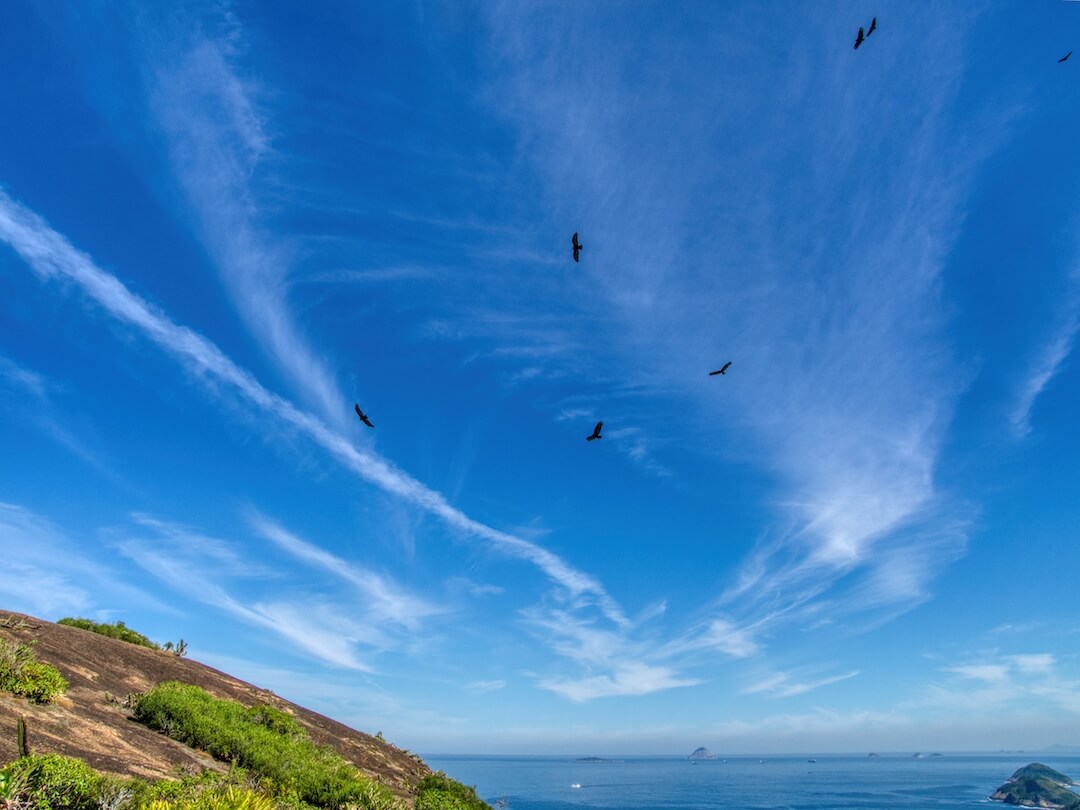
Vultures circle over Morro do Costão
I’ll need to retrace my steps for the return leg to the trail entrance. Which includes tackling the super-steep section just above the rope handrail – but this time heading down. After a quick risk assessment I decide to scramble down on all fours like a deranged crab. Just the two points for artistic impression but it does the trick.
Finally, I reach the trailhead and confirm my return with the steward. The steep descent has had its way with my calf muscles, which are now begging for some downtime.
Thankfully, the beach is but a mere ten-minute walk away.
Never miss a post - subscribe to our newsletter on Substack
Itacoatiara Beach
Unlike many other Rio de Janeiro and Niterói beaches, Itacoatiara dispenses with a backdrop of wall-to-wall apartment blocks and hotels in favour of one oozing in natural beauty.
With just a sprinkling of low-level holiday homes and a handful of kiosques (small bar/restaurants) lining the edge of the beach (but mainly hidden from view) there’s also an absence of passing traffic to break the sound of the surf-friendly waves.
It’s undoubtedly our favourite beach here, and one we’ve returned to many times.
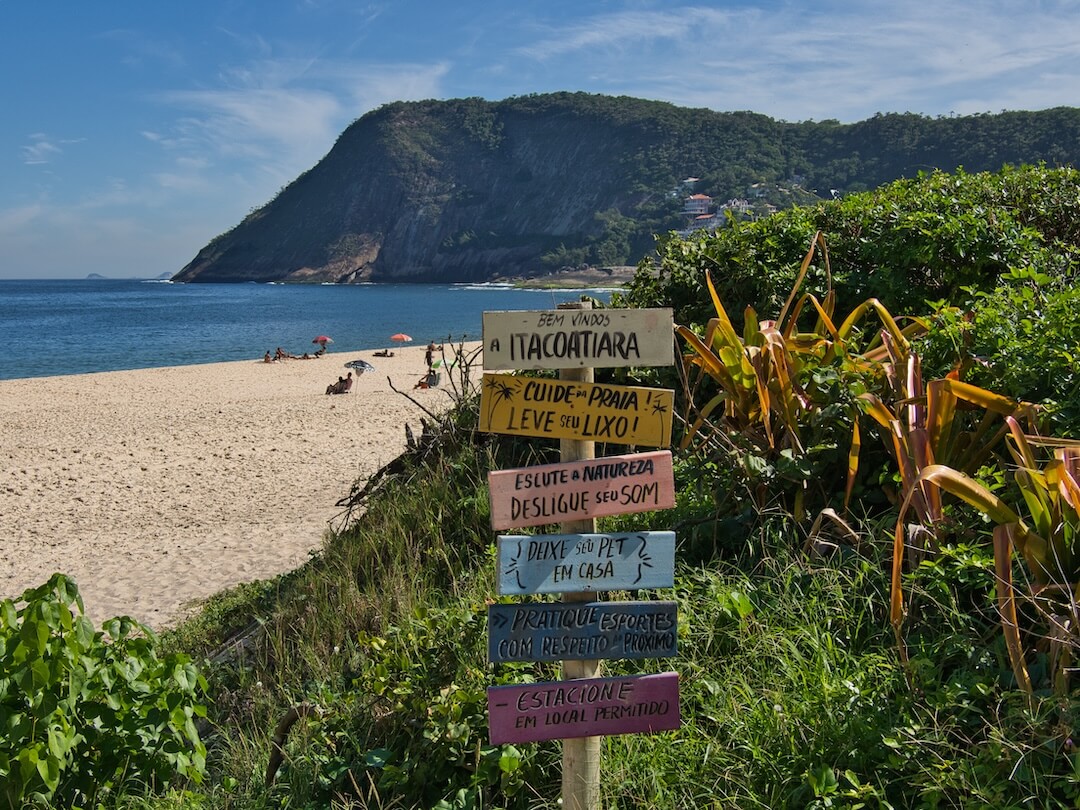
Why do we love it so much?
Well, for a start, the sand is fine, white powder and super-clean. The stunning backdrop of Parque Estadual da Serra de Tiririca, with its combination of lush vegetation and bare granite, is matched only by Ipanema. And when the surf is up, the waves crash ashore in thunderous fashion.
In fact, if you’re into surfing – or enjoy watching amateurs and professionals alike do their thing – Itacoatiara Pro is an annual festival on the beach featuring surfers, bodysurfers and bodyboarders.
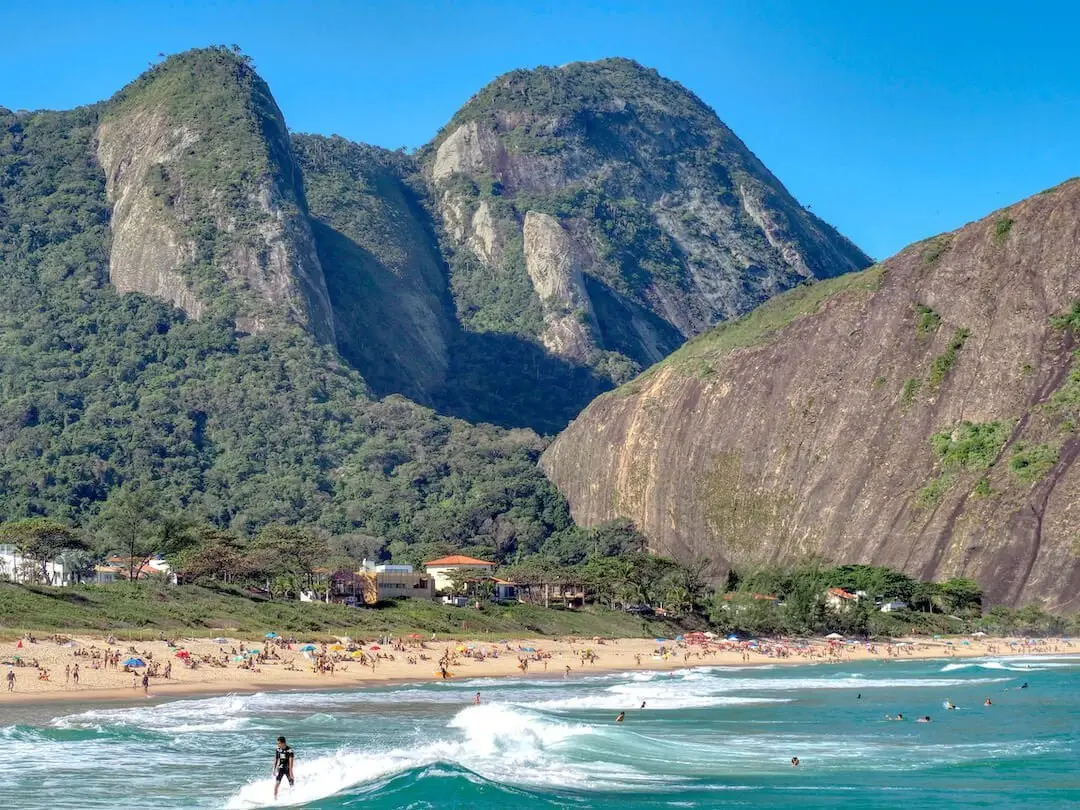
Of course, good surfing conditions don’t exactly make for safe swimming. However, at the far end of the beach, a lagoon-style section known as Prainha has a safer bathing area more suited to families.
Otherwise, most people opt for a quick, refreshing dip or join an impromptu game of altinha – that ubiquitous Rio beach pastime in which a small group keep a ball in the air using their heads, shoulders, chests and feet.
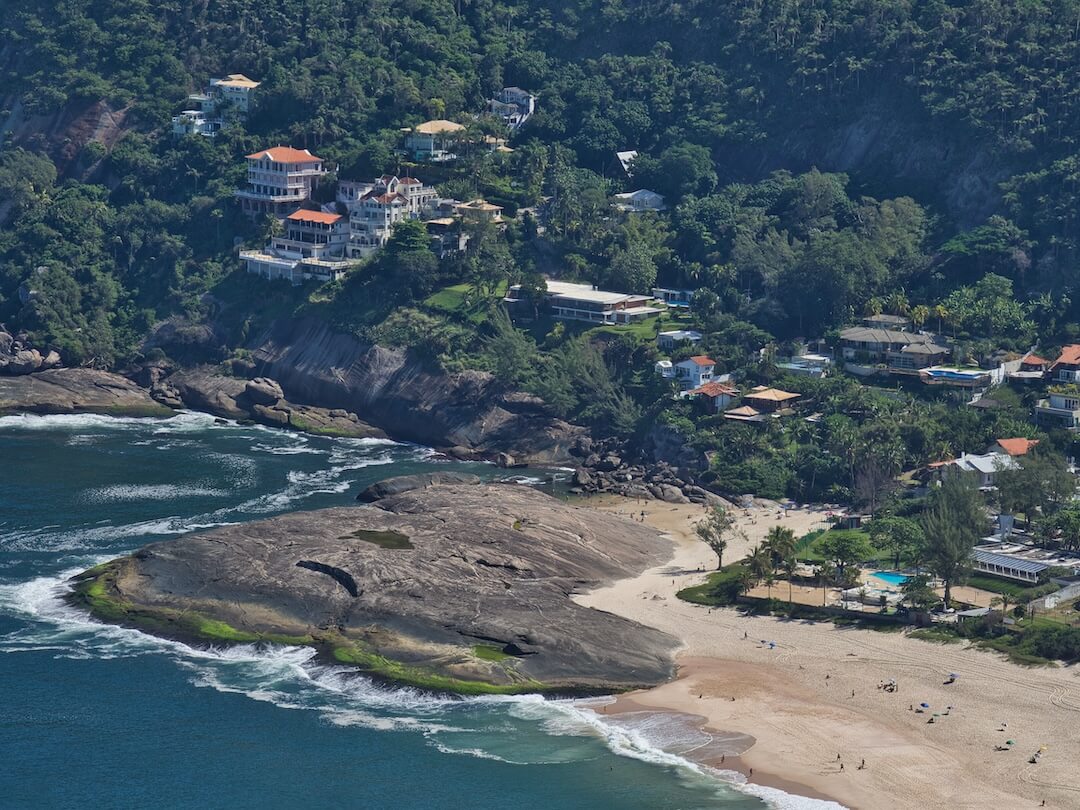
The western end of the beach (called “Prainha”) has a shallow lagoon for families
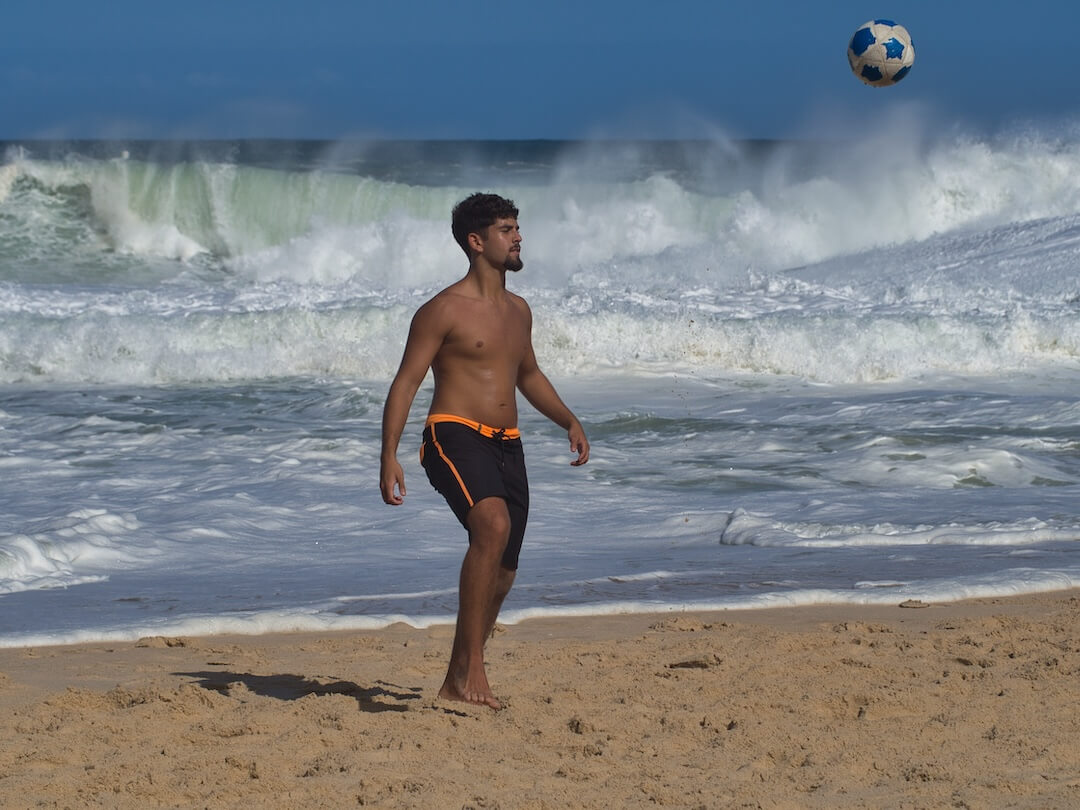
Where better to hone your “altinha” skills than on a powder sand beach in front of rolling surf
Getting there
Assuming that you’re based in Rio, the best (and cheapest) way to get to Itacoatiara is on a weekday by ferry and bus.
From the ferry terminal at Praça XV de Novembro, look out for the ferry crossing to Charitas (not Praça Araribóia, which is Niterói’s main terminal). The ferries run regularly on weekdays from 07:00 till 12:00, returning at 30-minute intervals from 16:30 (timetable). There’s no service at weekends.
Once at Charitas, cross the road to the bus stop and catch the OC1 or OC2 bus (OC stands for “Oceanico Atlantico”) to Itacoatiara. You’ll know you’ve arrived when the bus circles a small, blue police station on a roundabout. Get off at the next stop and walk back along Rua Matia Sandri for about ten minutes, until you arrive at the beach.
To go at the weekend you’ll need to take the ferry to Praça Araribóia and pick up the OC1 or OC2 from the bank of bus stops a couple of hundred metres or so to the right. It’s a longer route as the bus takes 20 minutes or so to reach Charitas before heading off to the Atlantic coast. If there’s a group of you, it might be easier to order an Uber instead.
If you have your own wheels there are parking spaces along the road at the back of the beach. Although these get taken up very quickly so you’d be best arriving early.
Praça XV de Novembro Ferry Terminal
Praça Araribóia Ferry Terminal
Charitas Ferry Terminal
Praia de Itacoatiara
Costao de Itacoatiara
Pedra do Elefante
Our Travel Blog Essentials
WORDPRESS THEME: Our site is powered by DIVI from Elegant Themes.
PHOTO EDITING: We edit and finish all our photographs in Luminar NEO, a simple and powerful alternative to Photoshop, Lightroom etc.
PHOTO STORAGE: We store our ever-growing collection of photographs with Smugmug, which also doubles as a visually stunning platform to share and sell our images.
Remember: These are affiliate links, which means that if you make a purchase, we earn a small commission at no extra cost.
What did you think? Have you been to Itacoatiara Beach or hiked to Morro do Costao? Either way, we’d love to hear from you so please add your comments below.
Thanks for reading

Hi, we're Ian and Nicky, an English couple on a voyage of discovery around the world, and this blog is designed to reflect what we see, think and do. Actually, we'd like to think it also provides information, entertainment and inspiration for other “mature” travellers, too. So please feel free to pour yourself a glass of something suitably chilled and take a look around.
This is such a rich and lovely description of your experience! Thanks for all the details and information. I can’t wait to go back and live all of this again soon.
Thank you, Vanessa – for us, the place never loses its allure. Enjoy it when you return!